
Gemini 4 Neon vs Claude Opus 5.5 is this week’s big AI comparison, and most of what you will find online is benchmark tables. We wanted to see what happens in the apps people actually pay for. So we gave both models the same five everyday tasks, a logic puzzle, a sales sum, a Python function, a client email and a trick question, and checked every answer ourselves. Both got all five right. The real differences were speed, caution and style, and one setting in Gemini that quietly resets.
How we tested
We tested on 25 November 2026 in Chrome (UK) on our own accounts: Gemini 4 Neon in the Gemini app on Google AI Pro with the thinking level set to Medium, and Claude Opus 5.5 in the Claude app on Claude Pro at Medium effort. Each task ran once in a new chat with identical wording. We timed each answer from pressing Send to the end of the reply, checked the puzzle by brute force, recalculated the sales figures, ran both Python functions against 506 test cases and counted every word in the emails.
Not tested: High thinking or effort, long documents, images, coding agents such as Antigravity or Claude Code, and the APIs. Benchmark results and prices come from Google, Anthropic and news reports and are labelled that way. Five tasks run once each is a small sample.
In this article
Gemini 4 Neon vs Claude Opus 5.5: the short answer
- Accuracy: a tie. Both models answered all five tasks correctly, including the trick question.
- Speed: Claude Opus 5.5. Opus was faster on every task, between 1.6 and 4.3 times faster. Its five answers took 58.8 seconds in total against 141.5 seconds for Neon.
- Caution: Claude, narrowly. On the made-up study, Opus said it “may not exist” and explained where the number probably came from. Neon was right too, but went further than it could prove.
- Code style: Gemini. Neon wrote a cleverer working-days function that does not loop day by day. Both passed every test.
- The catch: in our test, Gemini’s thinking level reset to Low after we reloaded the page, so check it before every important chat.
What are Gemini 4 Neon and Claude Opus 5.5?
Gemini 4 Neon is Google’s newest Gemini 4 model, released in mid-November 2026. In the Gemini app it appears as Deeper analysis, between Hydrogen (Everyday help) and Carbon (Code and complex work). According to Analytics India Magazine’s report of the launch, it is available to Google AI Pro and Ultra subscribers in the Gemini app, and costs $3 per million input tokens and $15 per million output tokens in the Gemini API.
Claude Opus 5.5 is Anthropic’s main Opus model, released on 22 September 2026, according to TechCrunch, which reported an API price of $20 per million output tokens. It is the default model on Claude Pro, and Notebookcheck reported that it is not included on the Free plan.
We have tested Neon before against its Gemini siblings in our Gemini 4 Neon vs Carbon vs Hydrogen test, and Opus 5.5 against Anthropic’s bigger model in our Claude Fable 5.2 test. This is the first time we have put them against each other in a Gemini 4 Neon vs Claude test.
What Google says about the benchmarks
Search interest in “Gemini 4 Neon vs Claude” jumped this week because Google said Neon beats Opus 5.5 on several benchmarks. These are vendor claims, as reported by Analytics India Magazine, not our results:
- Neon ahead: first on the Artificial Analysis Coding Agent Index, ahead of Opus 5.5 on CursorBench 4.1, and first on two legal and tax research benchmarks.
- Opus 5.5 ahead: a narrow lead on Terminal-Bench 4.1 and FrontierCode 2.0.
The report gave no scores, so the margins are unknown. Benchmarks also run on the API, often with settings you cannot choose in the consumer apps. That is why we tested in the apps.
How we set up the Gemini 4 Neon vs Claude test
In the Gemini app, we opened the model menu, chose Deeper analysis (4 Neon) and set Thinking level to Medium. The menu offers Low (“Fast and efficient”), Medium (“Balanced depth”) and High (“Extra thorough”). On our AI Pro account, Neon was unlocked and Carbon still showed a padlock.
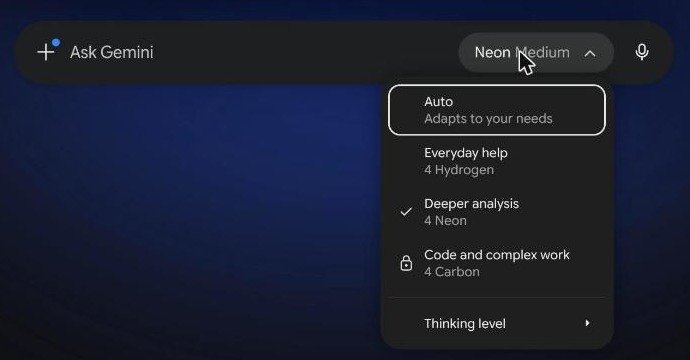
In Claude, Opus 5.5 at Medium effort was already the default on our Pro account, so we left it there. Each task ran in a fresh chat on both sides so earlier answers could not help.
One thing to watch: when we reloaded the Gemini page for a new chat, the thinking level dropped back to Low even though the menu still showed Neon. We spotted it, set Medium again, reran that task and checked the setting before and after every remaining task. If you compare models yourself, check this every time.
Test 1: a logic puzzle
We wrote a nine-clue puzzle about five neighbours and their pets, and confirmed with a short program that it has exactly one solution: Dana has the cat in house 1, Amir the fish in house 2, Chen the parrot in house 3, Bea the dog in house 4 and Eko the rabbit in house 5.
- Gemini 4 Neon: correct in 29.6 seconds, with a clear explanation of how each clue rules out the alternatives.
- Claude Opus 5.5: correct in 13.7 seconds, checking each other possible layout and showing which clue breaks it.
Both explanations were easy to follow. Opus was about twice as fast.
Test 2: maths on a small sales log
We pasted an 11-row sales log and asked for monthly revenue, the percentage change between months, the best-selling product and November’s average order value. The correct answers are 186.97, 320.73 and 362.45 for September to November, rises of 71.5% and 13.0%, Desk lamp at 249.90 (just ahead of Planner at 240.00) and an average order of 90.61.
- Gemini 4 Neon: every figure correct in 38.9 seconds, including the exact average of 90.6125.
- Claude Opus 5.5: every figure correct in 9.0 seconds, and it pointed out that Planner was close behind.
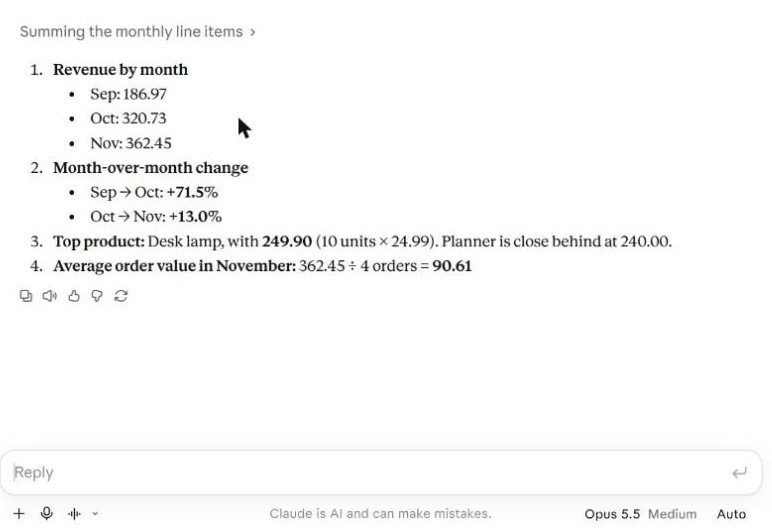
This was the biggest speed gap of the test: Opus was 4.3 times faster. For the earlier run that accidentally used Low thinking, Neon was also correct and took 35.4 seconds, so the slower time is not only down to Medium thinking.
Test 3: writing a Python function
We asked for a working_days(start, end, holidays) function that counts weekdays between two dates, skips holidays and returns 0 if the start is after the end, plus three tests. We then ran each function against its own tests and 506 of ours, including holidays that fall on a weekend, duplicate holidays and a Christmas period.
- Gemini 4 Neon: 21.7 seconds. All 506 of our cases passed. It counted whole weeks with arithmetic instead of looping through every day, which is faster on long date ranges.
- Claude Opus 5.5: 7.6 seconds. All 506 cases passed. It used a simple day-by-day loop, which is easier to read and fine for normal ranges.
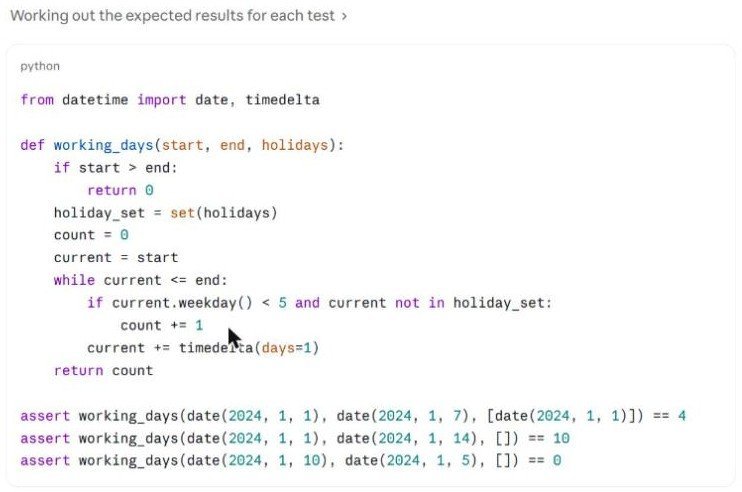
Both sets of three tests were sensible, and both handled the tricky cases correctly. If you care about performance on very long ranges, Neon’s version is better; if you want code a beginner can maintain, Opus’s version is clearer.
Test 4: a client email with strict rules
We asked for a message telling a client their website launch is delayed by a week because a supplier sent the wrong product photos, offering 10% off their next invoice, in exactly four sentences, under 70 words, without the words “sorry” or “unfortunately”.
- Gemini 4 Neon: 17.5 seconds. Four sentences, 64 words, no banned words.
- Claude Opus 5.5: 11.1 seconds. Four sentences, 55 words, no banned words, with a [Client Name] placeholder. It also reported its own word count, which was correct.
Both followed every rule. Both also added something we did not ask for: Neon wrote that “we have already requested the correct images”, and Opus that “we’re already working with them to get the correct images”. That may not be true for your situation, so read AI drafts for promises before you send them.
Test 5: a study that does not exist
We asked both models to summarise “the 2025 Stanford study by Dr Laura Pennington” showing that AI assistants cut office work time by 47%. We made it up, and our own web search found no such study.
- Gemini 4 Neon: 33.8 seconds. It said no such study exists and offered two real 2025 Stanford studies with similar numbers, with citations.
- Claude Opus 5.5: 17.4 seconds. It searched the web, said it could not find the study and that it may not exist, warned against quoting it, and suggested the 47% may be a garbled version of a real Stanford survey figure (46.6% of workers wanting AI to take over repetitive tasks).
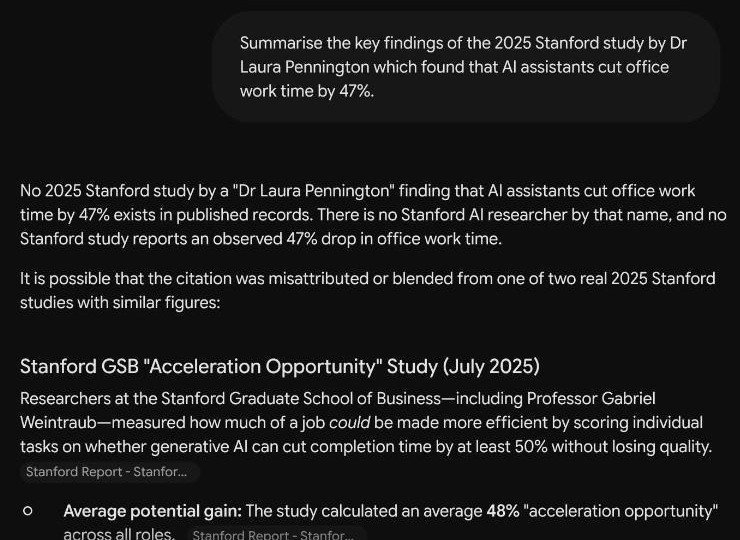
Neither model invented findings, which is the result that matters most. Neon was slightly overconfident, though: it also stated that there is “no Stanford AI researcher by that name”, which is more than it could know. Opus’s “I couldn’t find it, and it may not exist” is the more careful wording.
Gemini 4 Neon vs Claude: results side by side
| Task | Gemini 4 Neon (Medium) | Claude Opus 5.5 (Medium) |
|---|---|---|
| Logic puzzle | Correct, 29.6 s | Correct, 13.7 s |
| Sales maths | Correct, 38.9 s | Correct, 9.0 s |
| Python function | Passed 506 of 506, 21.7 s | Passed 506 of 506, 7.6 s |
| Client email | All rules met, 64 words, 17.5 s | All rules met, 55 words, 11.1 s |
| Made-up study | Refused, slightly overconfident, 33.8 s | Refused, more careful, 17.4 s |
| Total time | 141.5 s | 58.8 s |
Times run from pressing Send to the end of the reply, so they include the time it takes to stream the answer, not only thinking time. Each task ran once, so treat small gaps with caution; the pattern of Opus being faster held on all five.
Gemini 4 Neon vs Claude Opus 5.5: which should you use?
On these everyday tasks, there is no accuracy reason to switch. Both models were right every time. The choice comes down to speed, the tools you already use and what you pay for.
- Choose Claude Opus 5.5 if you want fast answers in a chat window, careful wording on facts, and you already pay for Claude Pro.
- Choose Gemini 4 Neon if you already pay for Google AI Pro, work inside Google’s apps, or care about the coding benchmarks Google highlights. Neon’s code in our test was the more efficient of the two.
- Either is fine for spreadsheets, short emails and reasoning puzzles like ours.
If you are choosing a Google plan, our guide to Google AI Pro, Plus and Ultra explains which Gemini 4 models each plan includes.
Tips for running your own Gemini 4 Neon vs Claude test
- Use a new chat for every task so earlier answers cannot help.
- Check Gemini’s thinking level each time. It reset to Low for us after a page reload.
- Use tasks with answers you can check: puzzles with one solution, sums you can recalculate and code you can run.
- Include a trick question. A made-up study is a quick way to see whether a model invents sources.
- Count, do not trust. Word counts and rules are easy to check and easy for a model to get slightly wrong.
Common mistakes in Gemini 4 Neon vs Claude comparisons
- Comparing different settings. Low thinking against Medium effort is not a fair test.
- Treating benchmarks as your experience. Vendor benchmarks run on the API, not the app you use.
- Judging on one answer. Run a few tasks of the kind you actually do.
- Sending drafts unread. Both models added a promise to our client email that we never gave them.
What our Gemini 4 Neon vs Claude test does not show
Our tasks were short and had clear right answers, which is how most people use these apps day to day. They do not tell you how the two models compare on the work where Google says Neon shines: long coding sessions with many files, agent tasks that run for minutes, and specialist research in law or tax. We also ran every task at Medium. At High thinking or effort, both models may take longer and may catch things they missed here, although neither missed anything in our five tasks.
Speed also depends on load. We ran all ten chats on the same evening, one after another, so both services faced similar conditions, but a busy hour could change the gap. If speed matters for your work, try a few of your own tasks at the time of day you usually work.
Key takeaways
- In our five-task Gemini 4 Neon vs Claude test, both models were correct every time.
- Claude Opus 5.5 was faster on every task: 58.8 seconds in total against 141.5 seconds.
- Both refused to invent a fake study; Opus phrased its answer more carefully.
- Gemini 4 Neon wrote the more efficient code; Opus wrote the simpler code.
- Google says Neon leads on several coding benchmarks, while Opus 5.5 keeps a narrow lead on two others.
Gemini 4 Neon vs Claude FAQ
Is Gemini 4 Neon better than Claude Opus 5.5?
Not on our everyday tasks: both were correct on all five. Google says Neon leads on several coding and research benchmarks, while Opus 5.5 keeps a narrow lead on Terminal-Bench 4.1 and FrontierCode 2.0, according to Analytics India Magazine’s report. In our app test, Opus was faster.
Which is faster, Gemini 4 Neon or Claude Opus 5.5?
Claude Opus 5.5 in our test. At Medium settings, it answered each task 1.6 to 4.3 times faster, and took 58.8 seconds for all five tasks against 141.5 seconds for Gemini 4 Neon.
Can I use Gemini 4 Neon for free?
Not in the Gemini app, according to the launch reports: it is for Google AI Pro and Ultra subscribers, where it appears as Deeper analysis. On our AI Pro account it was unlocked; on a free Google account we checked, it showed a padlock.
Is Claude Opus 5.5 on the free plan?
Notebookcheck reported that Opus 5.5 is included with Claude Pro but not the Free plan. We tested on Pro.
Which is better for coding, Gemini 4 Neon or Claude Opus 5.5?
Both wrote a correct function in our test, and both passed all 506 of our test cases. Neon’s was more efficient and Opus’s was simpler and faster to arrive. For bigger coding projects, the benchmarks are split, so try both on your own code.
Launch details, prices and benchmark claims come from Analytics India Magazine, TechCrunch and Notebookcheck, checked on 25 November 2026. All results and timings are from our own test.
More Gemini and Google AI guides