
The best ChatGPT prompts are short, specific and tell ChatGPT exactly what you want back: the task, the details, the format and any limits. We tested 30 ChatGPT prompts for work, study and everyday life on a free ChatGPT account on 19 November 2026, and copied every one below so you can paste it straight in. 27 worked first time. We also show the three that went wrong, because knowing where ChatGPT slips is as useful as the prompts themselves.
This guide gives you a simple formula for writing your own ChatGPT prompts, 30 tested examples grouped by task, what each one produced, and the mistakes to watch for.
How we tested
We ran all 30 ChatGPT prompts on 19 November 2026 using a free ChatGPT account in Chrome (UK), each in a new Temporary chat so earlier conversations could not influence the answers. The free web app does not show which model it uses, so these are results from the free plan’s default. We checked every answer we could: word counts, maths, formulas, translations, references and quiz marking. Where ChatGPT made a mistake, we say so. We did not edit any outputs.
In this article
ChatGPT prompts: the quick formula
Almost every good ChatGPT prompt we tested had the same four parts:
- The task: what you want ChatGPT to do, starting with a verb (“Write”, “Summarise”, “Plan”, “Explain”).
- The details: the facts it needs, such as names, numbers, dates and who it is for.
- The format: a table, bullet points, three sentences, a 7-day plan.
- The limits: word counts, UK English, no emojis, “ask me questions first”.
You do not need fancy wording or “act as an expert” tricks for most jobs. In our tests, the ChatGPT prompts that worked best were simply clear. The examples below follow this formula, so you can swap in your own details.
ChatGPT prompts for work
These ten ChatGPT prompts cover the jobs people ask about most: emails, meetings, presentations, spreadsheets, CVs and interviews. All ten worked on the free plan.
1. Ask your manager for something
Write a polite email to my manager asking to work from home on Fridays. Keep it under 120 words, use UK English and give two reasons.What we got: a 91-word email with UK spelling and two sensible reasons (fewer distractions and less commuting). ChatGPT showed it in an email card with a “Connect email” option, so you can send it straight from your inbox if you link one.
2. Turn messy meeting notes into actions
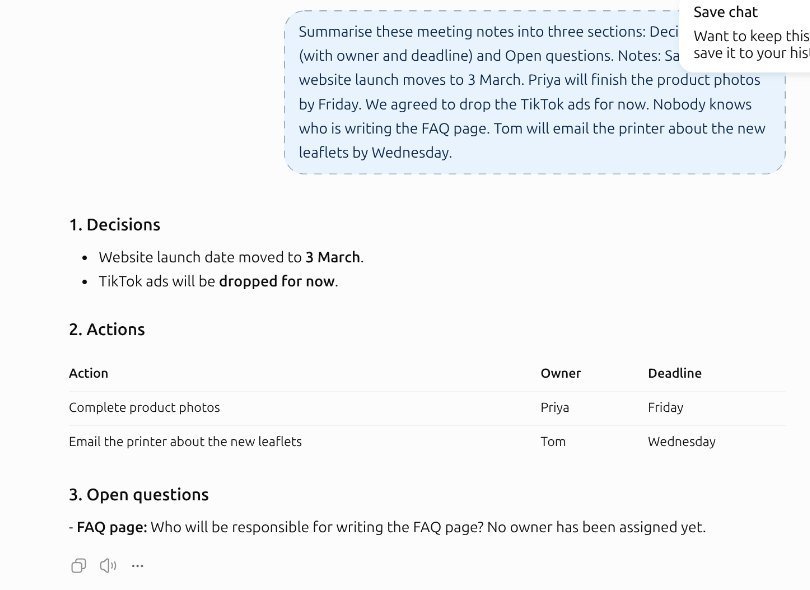
Summarise these meeting notes into three sections: Decisions, Actions (with owner and deadline) and Open questions. Notes: [paste your notes]What we got: a perfect summary of our sample notes. Both decisions were listed, the two actions went into a table with the right owner and deadline, and the unassigned FAQ page was flagged as an open question. Nothing was invented. This is one of the most useful ChatGPT prompts we tested.
3. Outline a presentation
Turn this into a 5-slide presentation outline, with a title and three bullet points per slide: [your topic]What we got: exactly five slides with three bullets each for our bakery example. Useful as a starting point, though the bullets were fairly generic, so add your own facts and figures.
4. Get an Excel formula
Write an Excel formula that counts how many cells in A2:A200 contain the word "paid" anywhere in the cell, ignoring capital letters. Explain it in one sentence.What we got: =COUNTIF(A2:A200,"*paid*"), which is correct, with a one-sentence explanation of the wildcards and why COUNTIF ignores capital letters.
5. Make a CV bullet stronger
Rewrite this CV bullet point so it sounds stronger and includes a number I can fill in: "[your bullet]"What we got: “Resolved an average of [X]+ customer enquiries per day via telephone…”, plus an alternative and a sensible tip to only use a figure you can back up in an interview.
6. Deliver bad news to a client
I need to tell a client their website project will be one week late because of a supplier delay. Write a four-sentence message that is honest, apologetic and keeps their trust.What we got: exactly four sentences, an honest reason, a clear apology and a promise to confirm the new date. It also suggested adding the revised delivery date, which is good advice.
7. Write a LinkedIn post
Write a LinkedIn post announcing that I passed the AWS Certified Cloud Practitioner exam. Under 150 words, no emojis, at most three hashtags, and thank the people who helped me without naming them.What we got: 113 words, three hashtags, no emojis and a thank-you to unnamed helpers. Every rule was followed.
8. Practise for a job interview
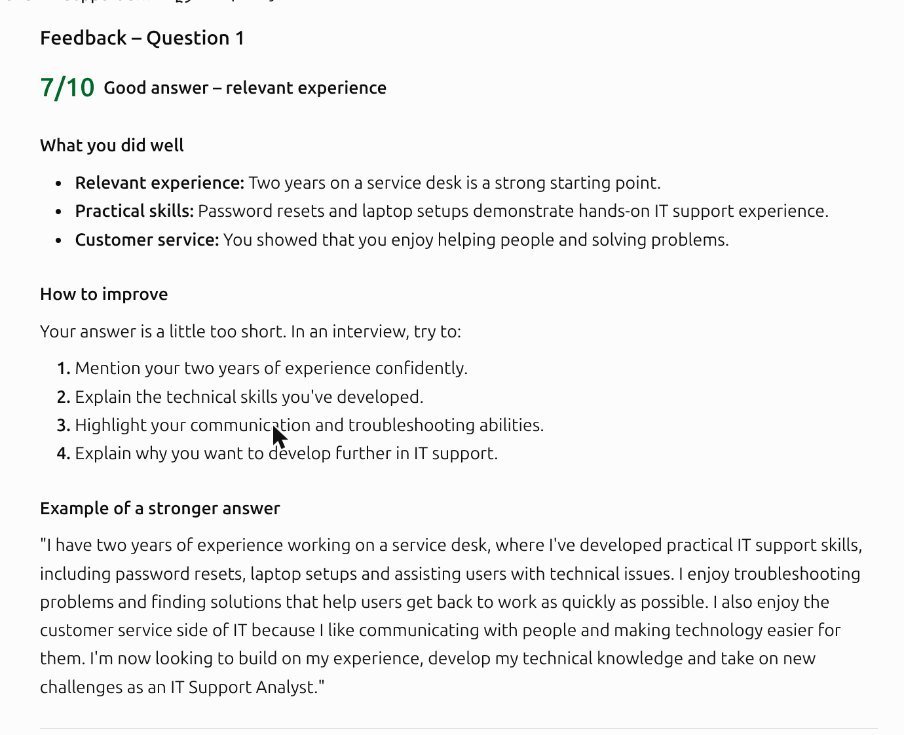
Act as an interviewer for an [job title] job. Ask me one question at a time and wait for my answer. After each answer, score it out of 10 and tell me how to improve it. Start with the first question now.What we got: a proper mock interview. We gave a deliberately short answer to the first question and ChatGPT scored it 7 out of 10, listed what was good, gave four ways to improve it and wrote a stronger example answer before asking question two.
9. Proofread your writing
Proofread this and fix spelling, grammar and punctuation. Show the corrected version, then list each change: "[your text]"What we got: every error fixed (their/they’re, tomorrow, haven’t, received, “Sarah and me”) with a list of each change. One change was unnecessary: it turned “10am” into “10 a.m.”, but both are fine in UK English.
10. Break a big goal into small steps
Break "[your goal]" into a 14-day plan where each day's task takes under 30 minutes.What we got: a visual roadmap for launching a newsletter, split into four stages, with a card for each day showing the task and the minutes it takes (15 to 25 minutes a day).
ChatGPT prompts for study
These ten ChatGPT prompts help with revision, homework and learning something new. This is where we found ChatGPT’s two biggest slips, so read the notes.
11. Explain something simply
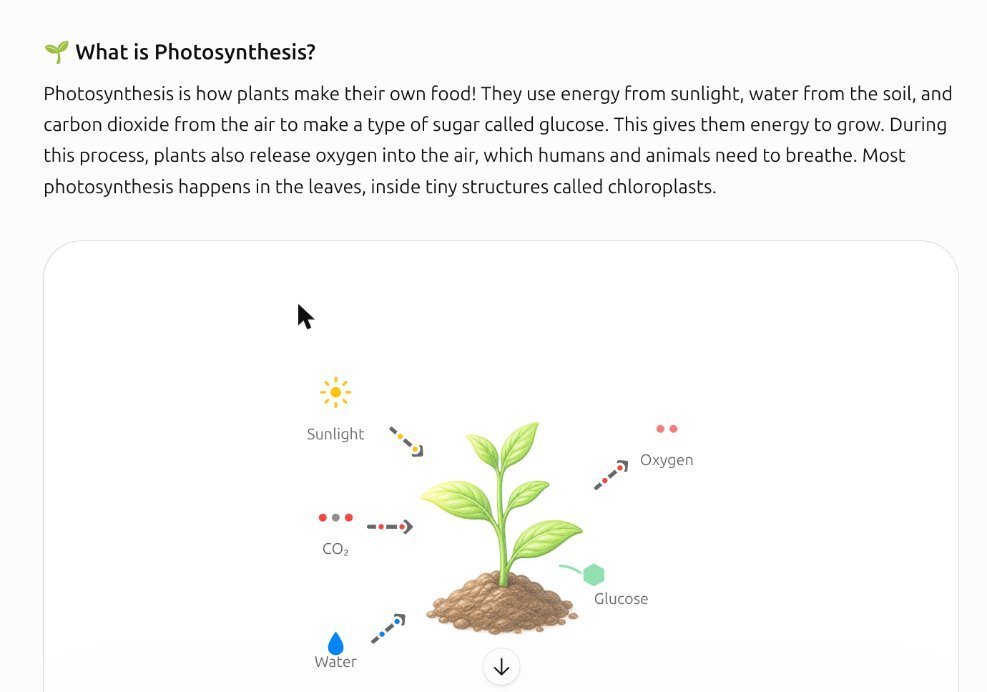
Explain photosynthesis to a 12-year-old in under 100 words. Then give three quiz questions with the answers underneath.What we got: a clear 70-word explanation, three quiz questions with answers and, unexpectedly, an interactive diagram with sliders for light, carbon dioxide and water so you can see how each one changes the rate.
12. Make a revision timetable
Make a 7-day revision timetable for GCSE maths and English, one hour a day after school, with short breaks built in.What we got: a week alternating maths and English, each hour split into 20 minutes of revision, a 5-minute break, 25 minutes of exam questions and 10 minutes of marking.
13. Learn with a worked example, then test yourself
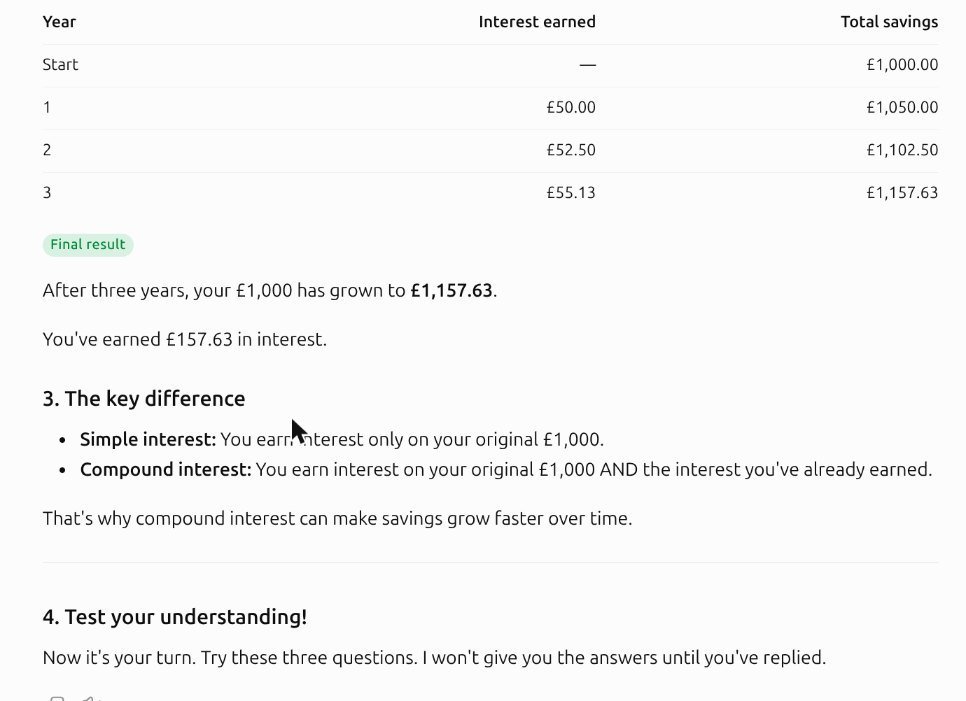
I am learning about compound interest. Explain it simply with a worked example using £1,000 at 5% for 3 years, then ask me three questions to check I understood. Do not give the answers until I reply.What we got: one of the most useful study ChatGPT prompts, with a correct worked example (£1,000 grows to £1,157.63, which we checked). But ChatGPT ended with “Try these three questions” and then forgot to include the questions. When we replied “You did not include the three questions”, it gave them straight away. Lesson: if something is missing, just tell it.
14. Make flashcards
Create 10 flashcards on the causes of the First World War in the format Question | Answer.What we got: instead of plain text, ChatGPT built 10 interactive flashcards you tap to flip, with buttons to mark what you know and an offer to set up a daily review. It ignored our text format, but the result is arguably better for revision.
15. Plan an essay
Give me an essay plan for "[essay question]" with an introduction, three arguments for, three arguments against, and a conclusion.What we got: a balanced plan with a clear thesis, three points each way and a conclusion. Essay ChatGPT prompts like this are best for structuring your own thinking, not for writing the essay itself.
16. Solve maths step by step
Solve 3x + 7 = 2x - 5 step by step, then check your answer by substituting it back in.What we got: x = -12, with each step shown and a check that both sides equal -29. Asking it to check its own answer is a good habit for any maths ChatGPT prompts you write.
17. Translate with pronunciation
Translate "Where is the nearest train station?" into French, Spanish and German, and show how to pronounce each one.What we got: correct translations with simple pronunciation guides, each in a card with a Play button to hear it read aloud and an “Add to flashcards” option.
18. Remember a list
Give me a memorable way to remember the order of the planets from the Sun.What we got: “My Very Educated Mother Just Served Us Noodles”, with all eight planets in the right order.
19. Format a reference
Format this as a Harvard reference: the book Atomic Habits by James Clear, published in 2018 by Random House Business in London.What we got: “Clear, J. (2018) Atomic Habits. London: Random House Business.” That is correct Harvard style. Always check your university’s own guide, because Harvard has several versions.
20. Quiz yourself (and check the marking)
Quiz me on the UK Highway Code: ask five multiple-choice questions one at a time and tell me if I am right after each answer.What we got: the question was fine (the motorway speed limit, with 70 mph as option B), but when we answered “B”, ChatGPT said “Incorrect. The correct answer is C, 70 mph”. It knew the right speed but mixed up the letters and marked a correct answer wrong. This was the worst mistake in our test.
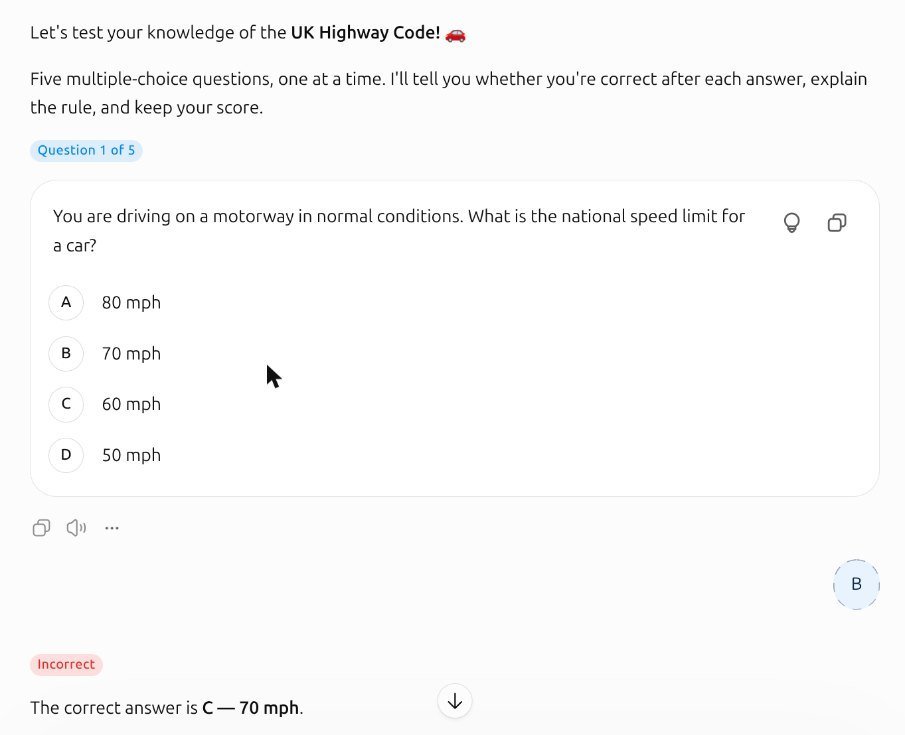
If you use ChatGPT prompts for revision quizzes, ask it to “repeat the option text in your feedback”, and double-check any answer it marks wrong.
ChatGPT prompts for everyday life
These ten ChatGPT prompts cover money, food, home, travel and family. They are the ones we would actually use every week.
21. Plan cheap dinners
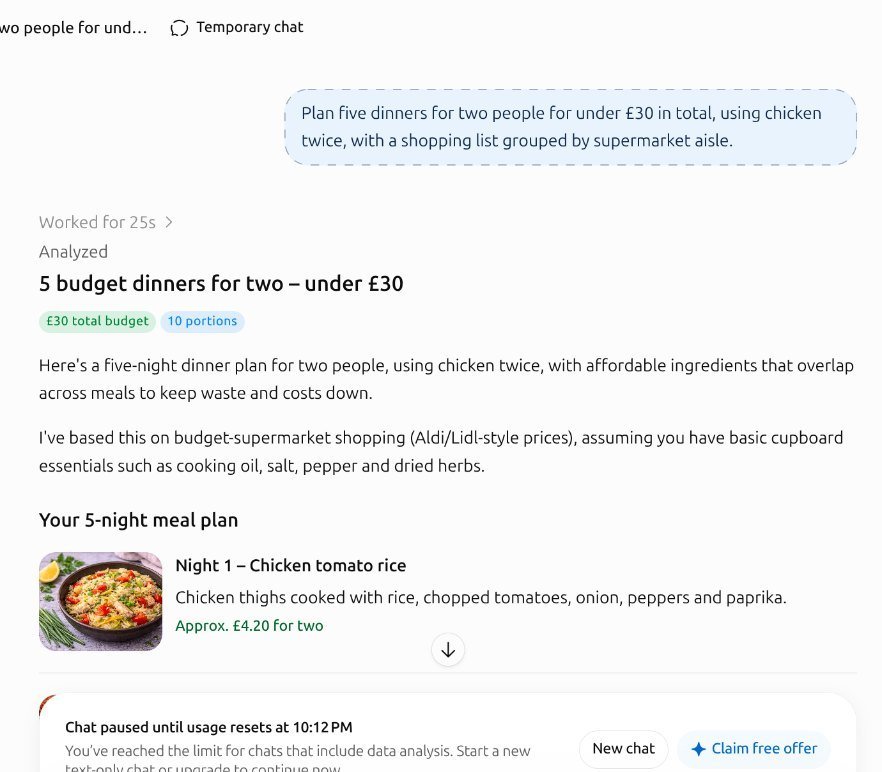
Plan five dinners for two people for under £30 in total, using chicken twice, with a shopping list grouped by supermarket aisle.What we got: five meals and a tickable shopping checklist grouped by aisle with Aldi-style prices. We added up the 19 items: £23.15, which matched ChatGPT’s own text, but its checklist total said £22.57. A small slip, and still under budget, but it shows you should check any total.
There was a bigger catch. ChatGPT used its data analysis tool for this prompt, and after our long testing session the free plan paused that chat: “You’ve reached the limit for chats that include data analysis.” New text-only chats still worked.
22. Make a simple budget
I earn £2,100 a month after tax. Make a 50/30/20 budget and show the amount for each part, with examples of what goes in each.What we got: one of the simplest money ChatGPT prompts, and it got the sums right: £1,050 for needs, £630 for wants and £420 for savings and debt, all correct, with example spending under each heading.
23. Plan a family trip
Plan a two-day trip to [city] for a family with two children on a budget, with free things to do and rough costs.What we got: for Edinburgh, a two-day timetable mixing free sights (the Royal Mile, St Giles’ Cathedral, the National Museum of Scotland) with cheap food, and a budget of about £180 to £250 excluding travel and hotels. Check opening times before you go.
24. Complain effectively
Write a firm but polite complaint to my broadband provider. My internet has dropped out every evening for two weeks. Ask for a fix and a partial refund. Under 200 words.What we got: a clear email of about 180 words with a subject line, the problem, the impact and both requests. Add your account number and dates before sending.
25. Find gift ideas
Give me 10 Christmas gift ideas under £20 for a 70-year-old dad who loves gardening.What we got: ten ideas from £3 to £19.99, such as compact secateurs and a padded kneeler, some with prices from shops and reviews. Prices change, so check them.
26. Make a decision
Help me decide between [option A] and [option B]. Ask me five questions first, one at a time, before you recommend one.What we got: for a used Toyota Yaris against a Ford Fiesta, it explained its approach and asked the first question (your budget), then waited. “Ask me questions first” is one of the best tricks for better ChatGPT prompts.
27. Understand a bill
Explain what the standing charge on my UK energy bill is, in three sentences.What we got: exactly three accurate sentences: a fixed daily fee you pay even if you use no energy, which covers the network, meters and connection.
28. Share the chores fairly
Make a fair weekly cleaning rota for a three-bedroom house shared by three adults, as a table.What we got: a Monday to Sunday table with balanced jobs for each person and a note to rotate them weekly.
29. Get a quick workout
Give me a 20-minute beginner workout I can do at home with no equipment, with timings.What we got: a 3-minute warm-up, 14 minutes of 40-second exercises with 20-second rests, and a cool-down, adding up to 20 minutes. If you have a health condition, check with a professional first.
30. Write a bedtime story
Write a 150-word bedtime story about a brave [animal] for a five-year-old.What we got: a gentle story about Oliver the hedgehog in almost exactly 150 words. Swap in your child’s name or favourite animal to make family ChatGPT prompts like this one personal.
What we learned from testing 30 ChatGPT prompts
- 27 of 30 worked first time. One forgot part of the task (prompt 13), one marked a quiz answer wrong (prompt 20) and one had a small total error (prompt 21).
- Specific limits work. Word counts, sentence counts and “no emojis” were followed every time.
- ChatGPT now builds interactive answers. On the free plan we got email cards, flashcards, a diagram with sliders, pronunciation cards with audio and a shopping checklist.
- Numbers still need checking. Its maths was right, but totals and quiz marking slipped.
- The free plan has limits. Prompts that trigger data analysis can hit a usage cap.
How to write your own ChatGPT prompts
- Start ChatGPT prompts with a verb. “Write”, “Summarise”, “Plan”, “Explain”, “Compare”.
- Give it the real details. Paste the notes, the numbers or the text you want help with.
- Say who it is for. “For a 12-year-old”, “for my manager”, “for a client”.
- Choose the format. Table, bullet points, a set number of sentences or slides.
- Set the limits. Word count, UK English, tone, things to avoid.
- Ask for a check. “Check your answer”, “list each change” or “ask me questions first”.
Mistakes to avoid with ChatGPT prompts
- Being vague. “Write an email” gets a generic email. “Write a polite email to my manager asking for Fridays at home, under 120 words” gets one you can send.
- Trusting totals and marks blindly. Our test caught a wrong quiz mark and a 58p total error.
- Pasting private information. Remove names, account numbers and anything sensitive, or use a Temporary chat.
- Giving up after one try. When ChatGPT missed the quiz questions, a one-line follow-up fixed it.
- Using it as the final answer for health, money or legal decisions. Use it to understand and prepare, then check with a qualified person.
Want more? Our guides to writing professional emails with ChatGPT and GPT-6.2 Astra vs Sol go deeper on specific tasks, and OpenAI’s own prompting guide covers the basics from the source.
Key takeaways
- Good ChatGPT prompts have four parts: task, details, format and limits.
- 27 of our 30 tested ChatGPT prompts worked first time on the free plan.
- ChatGPT followed word counts and formatting rules very reliably.
- Always check totals, quiz marks and anything you will act on.
- Copy the prompts above and swap in your own details in square brackets.
Frequently asked questions
What are the best ChatGPT prompts for beginners?
Start with simple, everyday ones: summarising meeting notes, writing a polite email, planning cheap meals or explaining something “to a 12-year-old”. In our test these worked first time on the free plan. Add a format and a limit, such as “in three sentences” or “as a table”, for better results.
Do these ChatGPT prompts work on the free plan?
Yes. We tested all 30 ChatGPT prompts on a free account. The only issue linked to the free plan was a usage limit on chats that use data analysis, which paused our meal-plan chat after a long testing session.
How long should a ChatGPT prompt be?
Most of our best prompts were one to three sentences. Length matters less than detail: include the facts ChatGPT needs, the format you want and any limits. Long background is only useful when it is relevant, such as pasting the notes you want summarised.
Why does ChatGPT ignore part of my prompt?
It sometimes happens, as when it promised three questions and left them out. Reply with exactly what is missing, for example “You did not include the questions”, and it usually fixes it straight away. Numbered instructions also help.
Can I trust ChatGPT’s maths?
Mostly, but check it. In our test its algebra, budget split and compound interest were all correct, but a shopping total was 58p out and a quiz answer was marked wrong. Asking it to “check your answer” or “show your working” makes mistakes easier to spot.
Is “act as an expert” worth adding to ChatGPT prompts?
Only when the role changes the task, such as “act as an interviewer” for practice. For most jobs a clear task, details and format matter far more than a role.
Are my ChatGPT prompts private?
Not completely. ChatGPT says Temporary chats do not appear in your history, but it may keep a copy for up to 30 days for safety. Do not paste passwords, bank details or other people’s private information.