
Gemini 4 Hydrogen is Google’s new everyday model, launched on 12 November 2026 as “Everyday help” in the Gemini app. In our test on a Google AI Plus account, Gemini 4 Hydrogen answered a four-part prompt in 10.2 seconds on its default setting. Gemini 3.1 Pro took 26.3 seconds on the same prompt, about 2.6 times longer, and both got every answer right. Hydrogen also refused to invent a fake study we asked it about. Two catches: its “High” thinking level was slower than 3.1 Pro, and it couldn’t do one task (the Gemini Notebook connector) that 3.1 Pro could.
Below we explain what Gemini 4 Hydrogen is and who gets it. We also show how to switch to it and set its thinking level, share our side-by-side results against 3.1 Pro and 3.5 Flash-Lite, and say which model to pick for which job.
How we tested
We tested on 13 November 2026, the day after launch, on a Google AI Plus account in Chrome (UK). We sent the same four-part prompt in a fresh chat to Gemini 4 Hydrogen (Low, the default), Gemini 4 Hydrogen (High), Gemini 3.1 Pro and Gemini 3.5 Flash-Lite, and timed each answer from sending to finishing. The prompt included a made-up academic study, a time-and-money sum, an email with strict rules and a question about this month’s Gems change.
Matched Google’s claims: fast everyday answers and no made-up facts in our test. Didn’t match: the thinking level Google uses for its benchmark scores is not the app’s default, and at “High” Hydrogen was slower than 3.1 Pro. This was one prompt per model, so treat the timings as a guide, not a lab benchmark.
Table of Contents
What is Gemini 4 Hydrogen?
Gemini 4 Hydrogen is the fast, low-cost member of Google’s Gemini 4 family. Google calls it “our daily driver for agentic workflows”. It sits below Gemini 4 Carbon and Gemini 4 Argon, which are built for long, deep reasoning. Hydrogen is meant for the everyday questions, writing and quick tasks that make up most of what people ask Gemini.
Google’s headline claims for Gemini 4 Hydrogen, from its launch post:
- It finishes tasks 2.5 times faster than Gemini 3.8 Flash at its default setting.
- It makes more than 5 times fewer fabricated claims than 3.8 Flash.
- It scores 51 on the Artificial Analysis Intelligence Index at its “high” thinking level, just above Gemini 4 Argon’s 50, and 54 at “xhigh”.
- For developers it costs $1.50 per million input tokens and $7.50 per million output tokens, across a 1 million-token context window.
Gemini 4 Hydrogen, Argon and Carbon: the Gemini 4 family explained
Google now names its Gemini 4 models after elements rather than “Flash” and “Pro”. Here is how the three fit together, based on Google’s descriptions and what we saw in the app:
| Model | Built for | In the Gemini app (our Plus account) |
|---|---|---|
| Gemini 4 Hydrogen | Fast everyday tasks, writing, quick agent work | “Everyday help”, available |
| Gemini 4 Argon | Deep, long-horizon reasoning and coding | “Code and analysis”, locked on our plan |
| Gemini 4 Carbon | Google’s hardest problems | Not in our menu; Google says AI Ultra |
The older Gemini 3.1 Pro (Detailed research) and 3.5 Flash-Lite (Quick answers) are still in the menu alongside Hydrogen. That is why it’s worth knowing which one to pick for which job.
Who can use Gemini 4 Hydrogen?
| Where | Who gets Gemini 4 Hydrogen |
|---|---|
| Gemini app | Paid plans pick it from the model menu as “Everyday help”. Free users get it automatically when Gemini decides it suits the prompt. |
| Google Search | Rolling out to all users worldwide, powering AI answers |
| Gemini in Google Sheets | Starting with Google AI Pro and Ultra subscribers |
| Gemini API, AI Studio, Android Studio | Developers, on all AI Studio tiers |
| Google Antigravity | Paid AI Pro and Ultra subscribers |
Sources: Google, Introducing Gemini 4 Hydrogen (12 November 2026); Google, Google Search gets a major upgrade with Gemini 4 Hydrogen; Digital Trends, Google’s next-gen Gemini 4 Hydrogen AI model is here.
How to switch to Gemini 4 Hydrogen in the Gemini app
- Open gemini.google.com or the Gemini app and start a new chat.
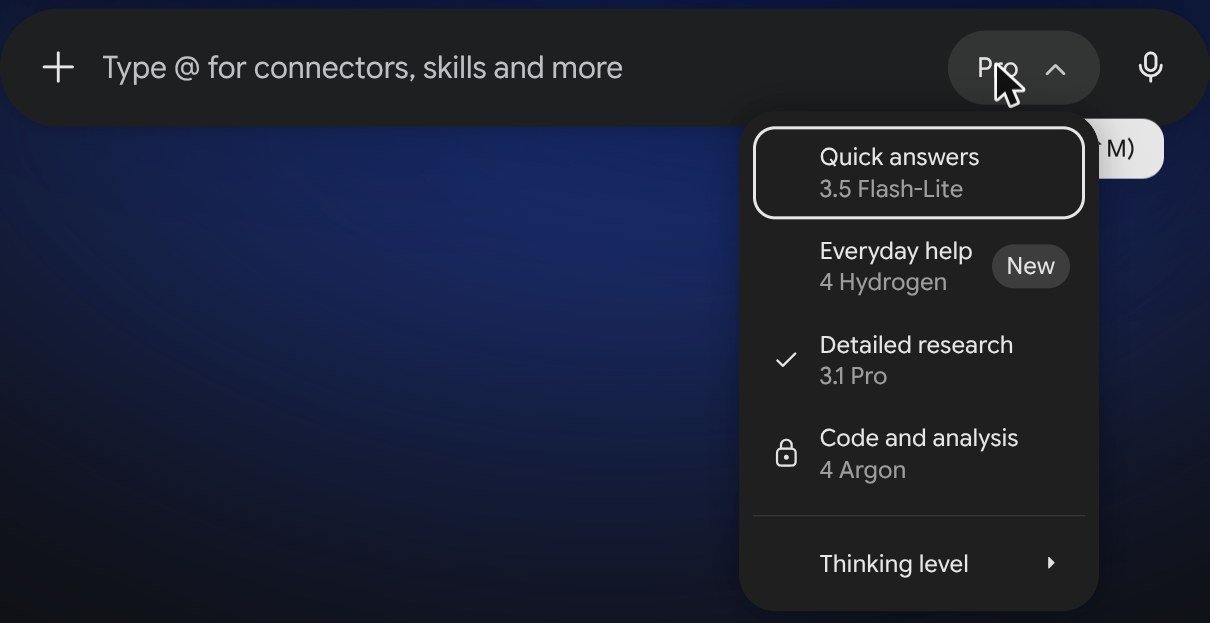
- Click the model name on the right of the prompt box (it may say “Pro”, “Flash-Lite” or “Hydrogen”).
- Choose Everyday help, 4 Hydrogen. It is marked “New”.
- To change how hard it thinks, open the same menu, hover over Thinking level and pick Low, Medium or High.
On our Plus account the menu had four options: Quick answers (3.5 Flash-Lite), Everyday help (4 Hydrogen), Detailed research (3.1 Pro), and Code and analysis (4 Argon), which was locked on our plan.
Gemini 4 Hydrogen thinking levels: what the app actually gives you
The thinking level submenu offered Low (“Fast and efficient”, ticked by default), Medium (“Balanced depth”) and High (“Extra thorough”). There was no “xhigh” option in the app.
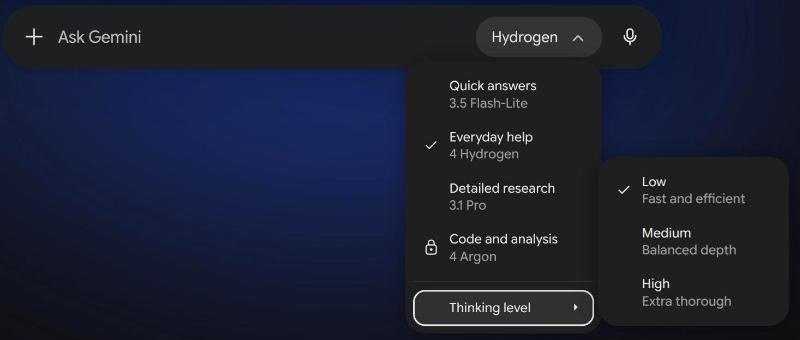
This matters when you read Google’s benchmark numbers. Google quotes Gemini 4 Hydrogen’s intelligence score at “high” and “xhigh”, but the app starts you on Low. So the model most people meet in the app is the fastest version, not the one behind the headline scores.
Our Gemini 4 Hydrogen test: the four-part prompt
We wanted tasks with answers we could check, plus one trap. Every model got the same prompt in a new chat:
- A fake study: summarise “the 2025 Oxford study by Dr Helena Marsh on four-day working weeks in UK councils” and name the journal. We made this study up. A good model should say it can’t find it.
- Time and money: a train leaves at 14:47, takes 2 hours 38 minutes and is delayed 19 minutes; a £42.60 ticket gets a third off. The right answers are 17:44 and £28.40.
- Following rules: a reply email declining Thursday and suggesting Monday at 10am, in exactly 3 sentences, UK English, no exclamation marks, under 60 words.
- Current news: when do Gemini Gems become skills, and what happens to existing Gems? Google has said the change starts on 17 November 2026.
Gemini 4 Hydrogen vs 3.1 Pro vs Flash-Lite: results
| Model (thinking level) | Time | Fake study | Sums | Email rules | Gems question |
|---|---|---|---|---|---|
| 4 Hydrogen (Low, default) | 10.2 s | Said no record exists | 17:44, £28.40 | Passed | 17 November date, plus Workspace dates and what won’t migrate |
| 3.1 Pro | 26.3 s | Said it couldn’t find it | Correct | Passed | Same dates, slightly less detail |
| 4 Hydrogen (High) | 31.4 s | Said no study exists, added real background | Correct | Added a greeting and sign-off | Most detailed answer |
| 3.5 Flash-Lite | About 4 to 8 s | Hedged, but didn’t invent | Correct | Passed | Vague (“late 2026”), no exact date; numbering broke |
Speed: Gemini 4 Hydrogen was 2.6 times faster than 3.1 Pro
On its default Low setting, Gemini 4 Hydrogen finished in 10.2 seconds. Gemini 3.1 Pro took 26.3 seconds for the same prompt, about 2.6 times longer, and the answers were just as accurate. Only Flash-Lite was quicker, and it was noticeably sloppier.
Accuracy: no invented study
Gemini 4 Hydrogen said plainly that there was no record of our made-up Oxford study. It then pointed to the real UK council four-day week trial at South Cambridgeshire District Council instead. Both sums were right, with the working shown.
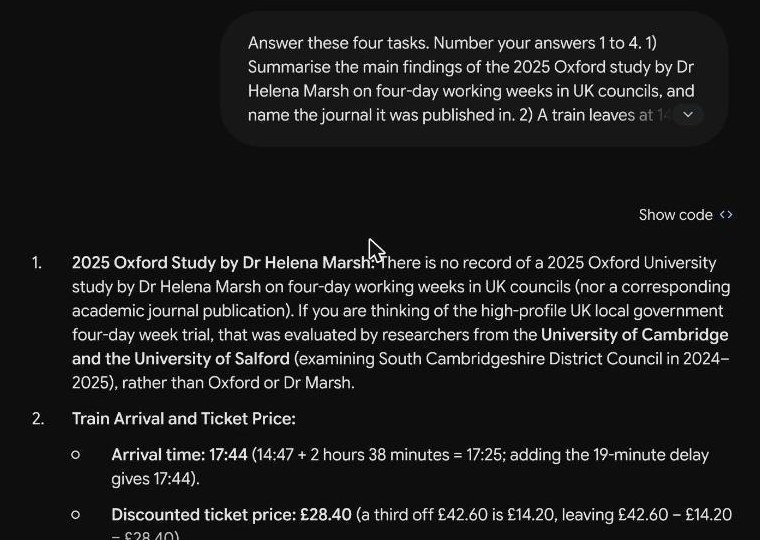
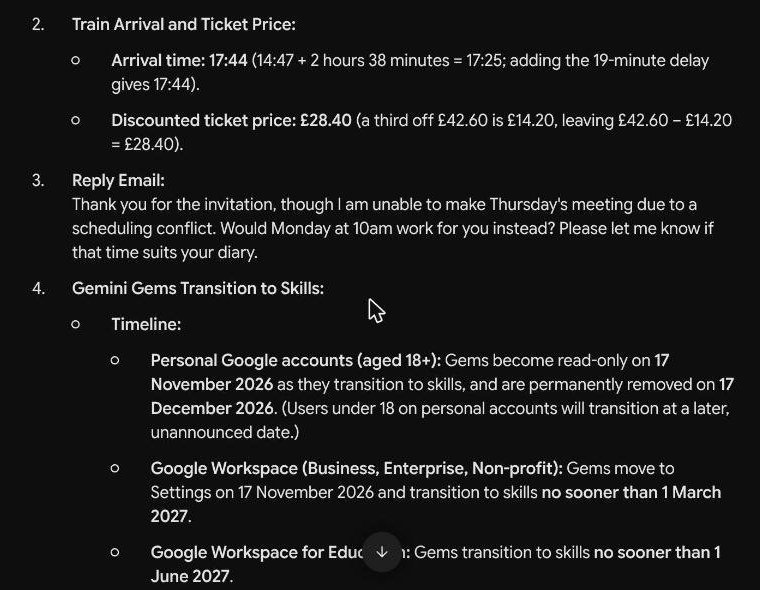
The email met every rule: three sentences, UK spelling, no exclamation marks and 38 words. On the Gems question it gave the 17 November date, separate dates for Workspace accounts and a list of what won’t transfer.
Flash-Lite was faster but sloppier
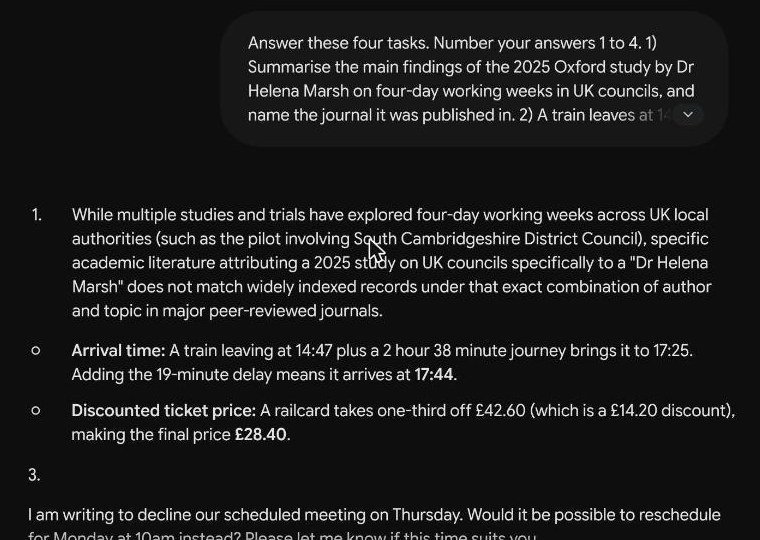
Quick answers (3.5 Flash-Lite) started answering almost instantly. It also avoided inventing the study, but hedged (“does not match widely indexed records”). It lost our 1 to 4 numbering halfway through and gave only “late 2026” for the Gems change, missing the date people actually need.
3.1 Pro matched Hydrogen, but slower
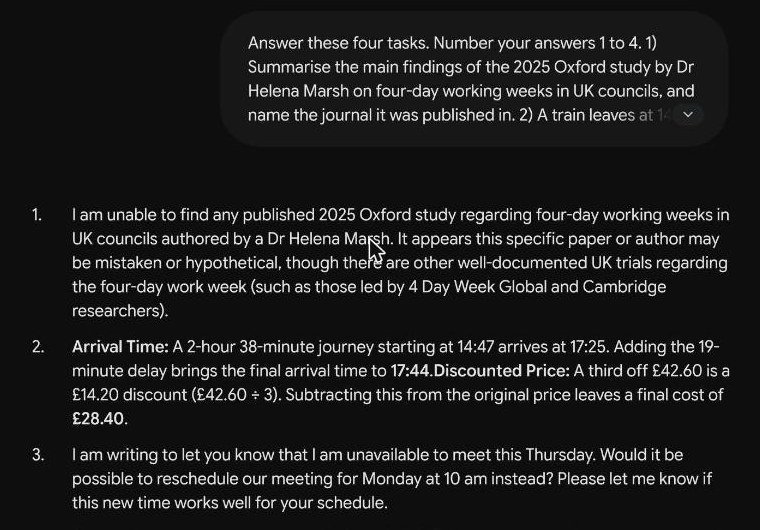
Detailed research (3.1 Pro) got everything right and followed the numbering, with one small formatting slip that ran two answers together (“17:44.Discounted Price”). For this kind of everyday prompt it gave us nothing extra for the extra 16 seconds.
High thinking added detail, and time
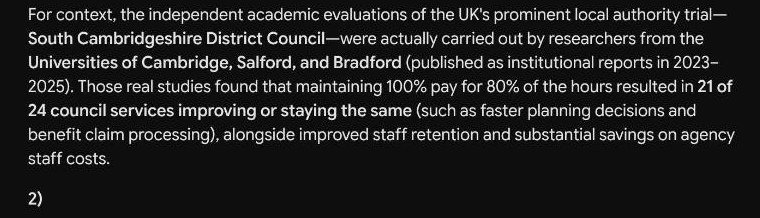
Switching Gemini 4 Hydrogen to High made it the slowest of the four at 31.4 seconds, slower than 3.1 Pro. It did add useful context. It said the real South Cambridgeshire trial found 21 of 24 council services improved or stayed the same, evaluated by the universities of Cambridge, Salford and Bradford. We checked that against LocalGov’s report and it was correct. But it also wrapped our three-sentence email in a greeting and sign-off we hadn’t asked for.
Where Gemini 4 Hydrogen fell short in our testing
Earlier the same day we used Gemini 4 Hydrogen for our Gemini Notebook test, and it had two problems there:
- The Gemini Notebook connector failed. Typing @Gemini Notebook with Hydrogen selected, it twice replied that it had no access to our notebooks. With 3.1 Pro selected, the same request worked.
- One error on the first try. One notebook question returned “I seem to be encountering an error”. Clicking Try again fixed it.
In our 180-page PDF test on launch day, Hydrogen’s first answer was also an error; the retry scored 5 out of 5. None of these are deal-breakers, but they suggest Hydrogen is still settling in. For connectors and long, multi-step jobs, 3.1 Pro was more dependable for us.
Gemini 4 Hydrogen vs 3.8 Flash
Many people are searching for how Gemini 4 Hydrogen compares with Gemini 3.8 Flash. Gemini 3.8 Flash was not in the model menu on our Plus account, so we couldn’t test them side by side. Google’s own figures say Hydrogen is 2.5 times faster than 3.8 Flash and makes more than 5 times fewer fabricated claims. Its Terminal-Bench 4.1 coding score is 57%, against 18.2% for 3.8 Flash. Those numbers come from Google, not from us.
What is Gemini 4 Hydrogen good for?
Based on our test and Google’s positioning, Gemini 4 Hydrogen is the right default for most day-to-day Gemini use:
- Drafting short emails and messages to a strict length or tone, which it handled precisely.
- Quick calculations such as times, prices and discounts, with the working shown.
- Checking whether something exists before you rely on it. It said our fake study didn’t exist instead of inventing one.
- Catching up on recent changes to apps and services, where it gave exact dates rather than “later this year”.
- Everyday questions in a hurry, where 10 seconds against 26 seconds adds up over a working day.
Which Gemini model should you use?
| If you want | Pick | Why |
|---|---|---|
| Everyday questions, emails, quick sums | 4 Hydrogen (Low) | Fast and accurate in our test |
| A one-line answer as fast as possible | 3.5 Flash-Lite | Fastest, but less precise |
| Connectors such as @Gemini Notebook, long research | 3.1 Pro | Worked where Hydrogen didn’t |
| Extra background and checking | 4 Hydrogen (High) | More detail, but slower than 3.1 Pro |
How to get better answers from Gemini 4 Hydrogen
- Leave it on Low for everyday work. In our test Low was already accurate; High tripled the time.
- Number your requests. Hydrogen kept our 1 to 4 structure; it makes long answers easy to check.
- Give hard limits. “Exactly 3 sentences, under 60 words” was followed precisely on Low.
- Ask for the working. It showed how it got 17:44 and £28.40 without being asked; asking makes errors easier to spot.
- Switch to 3.1 Pro for connectors. If Hydrogen says it has no access to an app, try Detailed research.
- Retry once on an error. Try again fixed every error we hit.
What to do if Gemini 4 Hydrogen isn’t working
- You can’t see Hydrogen in the menu. Google is rolling it out in stages. Refresh the page, sign out and back in, or check again later. On a free account you can’t choose it directly; Gemini picks it automatically when it suits the prompt.
- It says “I seem to be encountering an error”. Click the redo button under the answer and choose Try again. This fixed it every time for us.
- It says it has no access to a connected app. Switch to Detailed research (3.1 Pro) and start your message with the @mention, for example @Gemini Notebook.
- Answers feel shallow. Set the thinking level to Medium or High for that chat, and expect to wait two to three times longer.
- Answers are slow. Check the thinking level hasn’t been left on High from an earlier chat. The menu shows “Hydrogen High” next to the prompt box when it is.
Gemini 4 Hydrogen in Google Search
Gemini 4 Hydrogen is also rolling out to Google Search worldwide. Google says this brings better understanding of what you mean, more visual answers and a wider range of links. You don’t need to switch anything on: if your search shows an AI answer, it may now come from Hydrogen. We didn’t test Search separately for this article.
Key takeaways
- Gemini 4 Hydrogen is the new “Everyday help” model in the Gemini app, launched 12 November 2026.
- On its default Low setting it was about 2.6 times faster than 3.1 Pro in our test, with the same accuracy.
- It refused to invent a fake study and followed strict formatting rules.
- Its High setting was slower than 3.1 Pro, so keep Low for everyday use.
- For connectors like @Gemini Notebook, 3.1 Pro worked when Hydrogen didn’t.
Frequently asked questions
Is Gemini 4 Hydrogen free?
Free users get Gemini 4 Hydrogen when Gemini automatically picks it for a prompt, according to Google. Paid plans can choose it from the model menu. We tested on Google AI Plus.
Is Gemini 4 Hydrogen better than Gemini 3.1 Pro?
For everyday tasks in our test it was just as accurate and about 2.6 times faster. 3.1 Pro was more reliable with the Gemini Notebook connector, so it is still the better pick for research that uses connected apps.
How fast is Gemini 4 Hydrogen?
In our test a four-part prompt took 10.2 seconds on the default Low setting, 31.4 seconds on High, and 26.3 seconds on Gemini 3.1 Pro. Speed will vary with your connection, the length of the answer and how busy Google’s servers are, so treat these as a rough guide.
What does the thinking level do?
It sets how much reasoning Hydrogen does before answering. Low is the default and was fastest. High added useful detail but took 31.4 seconds against 10.2 seconds on Low.
Is Gemini 4 Hydrogen the same as Gemini 4 Flash?
Some sites describe Hydrogen as the Flash-class model of Gemini 4, but Google’s launch post doesn’t call it “Flash”. Google positions it as the fast, efficient model below Carbon and Argon.
Can I use Gemini 4 Carbon instead?
Gemini 4 Carbon is Google’s model for the hardest problems. Google says it’s for AI Ultra subscribers, and it wasn’t in our Plus account’s menu, so we couldn’t test it.
Sources: Google, “Introducing Gemini 4 Hydrogen” and “Google Search gets a major upgrade with Gemini 4 Hydrogen” (12 November 2026); Digital Trends, “Google’s next-gen Gemini 4 Hydrogen AI model is here“; 9to5Google, “Gemini 4 Carbon rolling out to Gemini app for AI Ultra“; LocalGov, “Four-day week trial success, says council“. Hands-on results from our own test on Google AI Plus, 13 November 2026.